Does Eating Fruit at Night Make You Gain Weight?
Eating fruit at night does not automatically cause weight gain. Learn what research says about meal timing, fruit sugar, body weight, and bedtime snacks.

You may have heard that eating a banana, apple, mango, or another fruit after dinner causes its sugar to be “stored as fat.” It is a popular claim, but it oversimplifies how body-weight regulation works.
For most people, eating a serving of whole fruit at night does not become unhealthy or cause weight gain simply because of the time of day. Research on whole-fruit intake does not suggest that it promotes obesity, while research on meal timing describes a much more nuanced relationship between circadian rhythms, total energy intake, and metabolism. (PubMed)
Meal timing is not necessarily meaningless. Chrononutrition—the study of how food timing interacts with circadian biology—is an active field of research. But its findings do not support the simplistic rule that “fruit at night makes you fat.” (PubMed)
Does eating fruit at night make you gain weight?
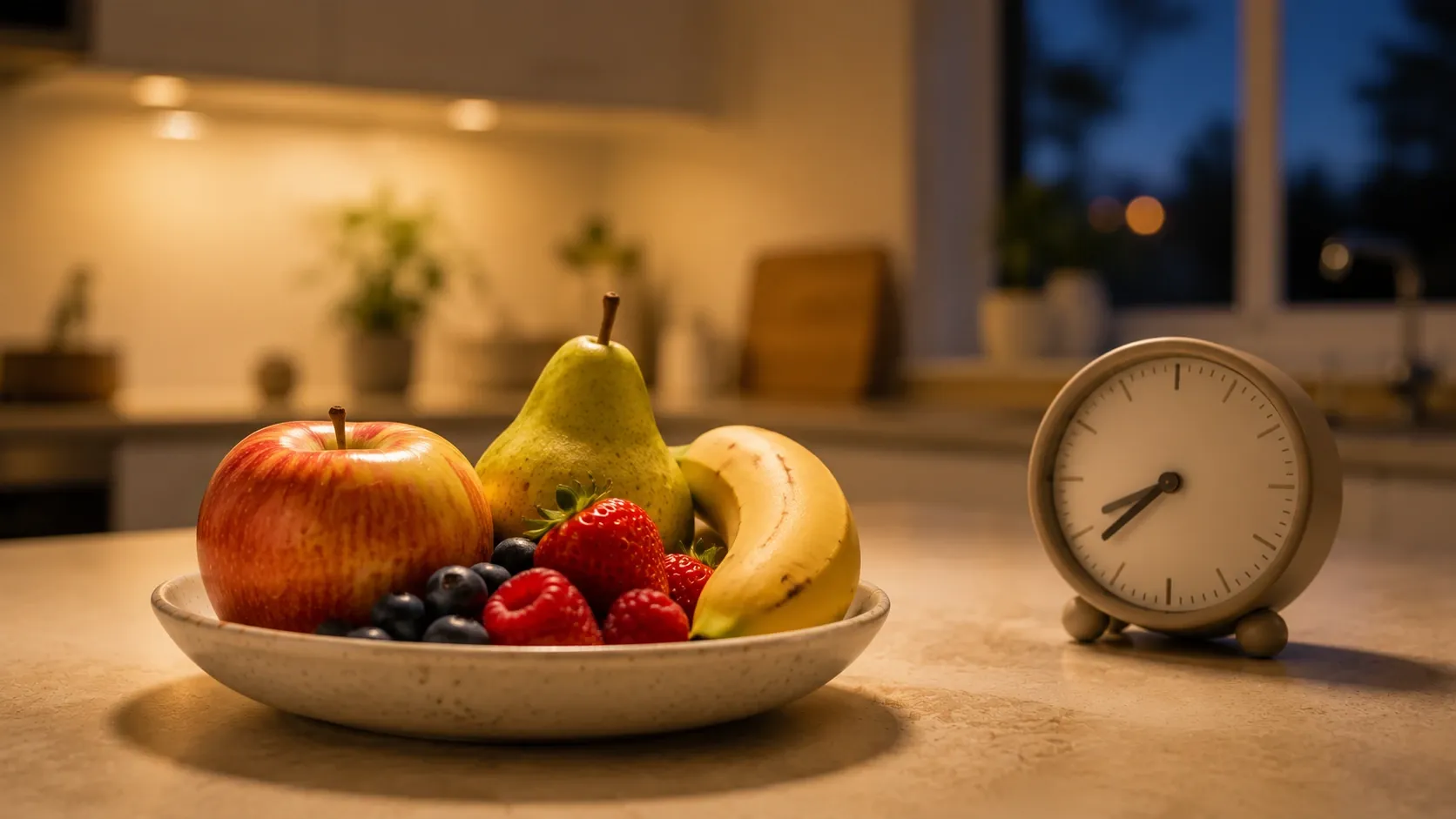
There is no evidence that whole fruit develops a special fattening property after sunset.
A systematic review published in Frontiers in Nutrition examined randomized trials and prospective studies on whole fruit, energy intake, body weight, and adiposity. Overall, whole-fruit consumption was unlikely to promote excess energy intake or adiposity and appeared to have either a neutral or modestly favorable relationship with weight control. (PubMed)
Body-fat gain occurs within a broader energy and dietary context. Fruit contains calories, like other foods, but the clock does not suddenly make those calories biologically equivalent to a completely different food.
WHO includes fruit among the primary sources of minimally processed carbohydrate foods in a healthy diet and describes energy balance as one of the core principles of healthy eating. (Organização Mundial da Saúde)
Why do people say that fruit at night is fattening?
The myth probably draws partly on a real scientific concept: our metabolism interacts with the body’s circadian clock.
Researchers have examined whether eating more of the day’s calories earlier or later affects weight and metabolic outcomes. A 2024 systematic review and meta-analysis in JAMA Network Open found small weight advantages with some meal-timing strategies, including earlier calorie distribution. However, the effects were small, studies were heterogeneous, and the clinical importance remained uncertain. (PubMed)
That does not establish a universal deadline for eating.
More importantly, these studies generally examine overall meal patterns, calorie distribution, eating windows, or meal frequency—not the isolated effect of eating a piece of fruit at night.
Can eating late affect metabolism?
It may in some circumstances. But that is different from saying that fruit at night causes weight gain.
In a controlled 2022 trial, adults with overweight or obesity ate calorie- and nutrient-matched diets on earlier and later schedules. Late eating increased hunger and altered energy expenditure and metabolic pathways related to adipose tissue. (PubMed)
The study provides useful evidence that meal timing can influence physiology. It did not test whether eating an apple, banana, or other fruit before bed causes body-fat gain.
Using this research as proof that “fruit after a certain hour turns into fat” would therefore go beyond what the experiment demonstrated.
What about the sugar in fruit?
Another common argument is that fruit should be avoided at night because it contains fructose and other naturally occurring sugars.
The problem is treating whole fruit as if it were equivalent to added sugar or a sugary beverage.
Whole fruit provides naturally occurring sugars within a matrix containing water, fiber, vitamins, minerals, and plant compounds. Harvard’s Nutrition Source notes that most whole fresh or frozen fruits have a relatively low glycemic load and that their intact form tends to make them more satisfying. (The Nutrition Source)
WHO also draws an important distinction. Its definition of free sugars includes sugars in honey, syrups, fruit juices, and fruit-juice concentrates, while whole fruit is included among recommended foods in a healthy dietary pattern. (Organização Mundial da Saúde)
So the statement “fruit contains sugar, therefore it is fattening at night” ignores both food structure and the overall evidence.
Are whole fruit and fruit juice equivalent?

No.
Eating whole fruit preserves its physical structure and fiber, making it slower to consume and generally more filling. Juice makes it easier to consume the equivalent of multiple pieces of fruit in a short period of time. (The Nutrition Source)
WHO notes that even fruit juices with no added sugar can contain meaningful amounts of free sugars and recommends limiting them. (Organização Mundial da Saúde)
A 2024 systematic review and meta-analysis in JAMA Pediatrics evaluated 42 studies on 100% fruit juice and body weight. Greater juice intake was associated with a small BMI increase among children. In adults, the association was mainly apparent in analyses that did not adjust for total energy intake, suggesting that additional calories may explain part of the relationship. (JAMA Network)
Research on juice therefore should not be used as evidence that whole fruit is fattening.
Can you eat fruit at night while trying to lose weight?

Yes. For most people, there is no scientific reason to automatically remove fruit from the evening.
Whole fruit may be particularly practical when it replaces a more energy-dense dessert or snack. Evidence on whole fruit suggests that it does not promote weight gain and may help constrain energy intake in some contexts. (PubMed)
That does not mean fruit can never contribute to excess calorie intake. Portion size and preparation still matter, especially when several fruits are combined with sweetened creams, syrups, sugary granola, or other calorie-dense ingredients.
The important point is not to make the clock more important than the overall dietary pattern.
What if you are hungry before bed?
Whole fruit can be a straightforward option. Depending on appetite and individual nutritional needs, it can also be combined with another food such as plain yogurt or a small portion of nuts.
The broader questions are whether the snack is needed, how large it is, and how it fits into the day’s overall intake.
Are there fruits you should avoid at night?
For healthy people, there is no universal list of fruits that become unsuitable after a certain hour.
Bananas, apples, pears, papaya, melon, berries, kiwi, mangoes, grapes, and other fruits can all fit into an evening eating pattern. Overall portion size and dietary context are more meaningful than rigid rules based on the clock. (The Nutrition Source)
There are, however, individual situations in which eating close to bedtime deserves more attention.
Acid reflux and digestive discomfort
People with gastroesophageal reflux disease may notice that certain foods worsen their symptoms. NIDDK lists acidic foods, including citrus fruit, among commonly reported triggers. (Instituto Nacional de Diabetes e Doenças Digestivas e Renais)
For people with nighttime reflux, NIDDK states that eating meals at least three hours before lying down or going to bed may improve symptoms. This recommendation concerns reflux management—not weight gain from fruit. (Instituto Nacional de Diabetes e Doenças Digestivas e Renais)
What matters more than banning fruit at night?
Instead of focusing only on whether fruit is allowed after 8 p.m., it is more useful to consider the wider pattern.
If someone reaches the end of the day extremely hungry because they have eaten very little earlier, meal structure may deserve attention. If the evening routinely includes large amounts of calorie-dense snacks and sugary drinks, removing one piece of fruit is unlikely to address the main issue.
Chrononutrition research suggests that the distribution of food intake across the day may have metabolic relevance. However, the effects identified so far are generally modest and do not justify labeling a nutritious food as unhealthy simply because it is eaten in the evening. (PubMed)
Conclusion
Eating fruit at night does not automatically cause weight gain or harm your health.
The best available evidence on whole fruit indicates that it does not promote obesity and can fit comfortably within a weight-management eating pattern. (PubMed)
Meal timing can influence some aspects of metabolism, and very late eating is a legitimate area of research. But that is very different from claiming that a piece of fruit before bed will automatically be converted into body fat. (PubMed)
In practice, it makes more sense to prioritize whole fruit, appropriate portions, a balanced overall diet, and sustainable eating habits rather than following arbitrary rules about the clock.