Does Intermittent Fasting Work for Weight Loss?
Intermittent fasting can support weight loss, but it does not consistently outperform conventional calorie restriction. Learn what the latest evidence shows and who should be cautious.

Yes, intermittent fasting can help with weight loss. But saying that an approach works is different from saying that it works better than every alternative.
The best available evidence suggests that intermittent fasting can reduce body weight, but it does not consistently produce substantially more weight loss than conventional energy-restricted diets. It is better understood as one possible way of organizing food intake rather than a guaranteed metabolic shortcut. (Cochrane Library)
For some people, limiting the hours available for eating makes it easier to reduce daily energy intake. For others, hunger, work schedules, exercise routines, or social commitments make fasting difficult to sustain.
What is intermittent fasting?

Intermittent fasting is an umbrella term for eating patterns that alternate periods of food intake with periods of little or no energy consumption.
One of the most extensively studied approaches is time-restricted eating, in which meals are consumed within a defined daily window. The NIDDK notes that six- to eight-hour eating windows are commonly studied forms of this approach. (NIDDK)
Common approaches include:
| Approach | Typical structure |
|---|---|
| 14 | About 14 hours fasting and a 10-hour eating window |
| 16 | About 16 hours fasting and an 8-hour eating window |
| 5 | Usual eating on five days with substantial energy restriction on two days |
| Alternate-day fasting | Alternating usual-intake days with fasting or very-low-energy days |
These strategies should not be treated as interchangeable. Different schedules can produce different levels of energy restriction and adherence. (BMJ)
Why can intermittent fasting lead to weight loss?
The practical explanation is relatively straightforward.
Reducing the number of hours available for eating may eliminate some meals, snacks, or late-night eating opportunities. This can reduce total daily energy intake.
In a randomized trial published in the Annals of Internal Medicine, adults with obesity assigned to an eight-hour eating window without calorie counting spontaneously reduced their energy intake and lost weight over 12 months compared with a control group. (PubMed)
This does not mean energy balance stops mattering during fasting. NIDDK commentary on the research similarly notes that reduced calorie intake appears to be an important part of why time-restricted eating leads to weight loss. (NIDDK)
Is intermittent fasting better than conventional dieting?
For most comparisons, not by a clinically important margin.
A Cochrane review published in February 2026 included 22 studies involving 1,995 participants. In the main comparison with traditional dietary advice, 21 studies involving 1,430 people found little to no difference in percentage weight loss. The certainty of this evidence was rated low. (Cochrane Library)
A separate meta-analysis examining interventions lasting at least six months reached a similar conclusion: intermittent fasting and continuous calorie restriction were broadly comparable for reducing body weight and adiposity. (PubMed)
Individual trials support this interpretation. A 12-month trial published in the New England Journal of Medicine found that adding time-restricted eating to calorie restriction did not significantly improve reductions in body weight, body fat, or metabolic risk factors compared with calorie restriction alone. (PubMed)
Have any fasting approaches performed better?
Yes, although the size of the difference matters.
A 2025 BMJ network meta-analysis included 99 randomized clinical trials with 6,582 adults. Intermittent-fasting strategies and continuous energy restriction both reduced weight compared with unrestricted diets. (BMJ)
Alternate-day fasting was the only intermittent-fasting strategy that showed a statistically significant advantage over continuous energy restriction for body weight, with an additional reduction of about 1.29 kg. (PubMed)
That is a modest difference. It does not establish that fasting in general dramatically accelerates metabolism or that alternate-day fasting is the best practical approach for everyone.
Is there anything special about the 16 method?
The 16
approach has become popular partly because of its simplicity: food is consumed within an eight-hour period and the remaining 16 hours are spent fasting.However, there is no strong evidence that 16 hours represents a unique metabolic threshold required for successful fat loss.
In a 12-month randomized trial involving 90 adults with obesity, an eight-hour eating window produced an estimated 4.61 kg weight reduction relative to the control group. Daily calorie restriction produced a 5.42 kg reduction relative to control. There was no statistically significant difference between the two active strategies. (PubMed)
The findings suggest that an eight-hour eating window can work without implying that it is the only effective fasting schedule.
Do you still need to think about calories?
For some people, one practical advantage of intermittent fasting is that they do not need to track every calorie.
If a shorter eating window naturally leads to lower energy intake without excessive hunger or a sense of constant restriction, it may be a useful approach.
In the 12-month trial by Lin and colleagues, average reductions in reported energy intake were similar between the time-restricted eating and daily calorie-restriction groups. (PubMed)
But it is entirely possible to fast for 16 hours and then consume enough energy during the remaining eight hours to maintain or gain weight.
The clock determines when you eat. It does not make how much or what you eat irrelevant.
Food quality still matters
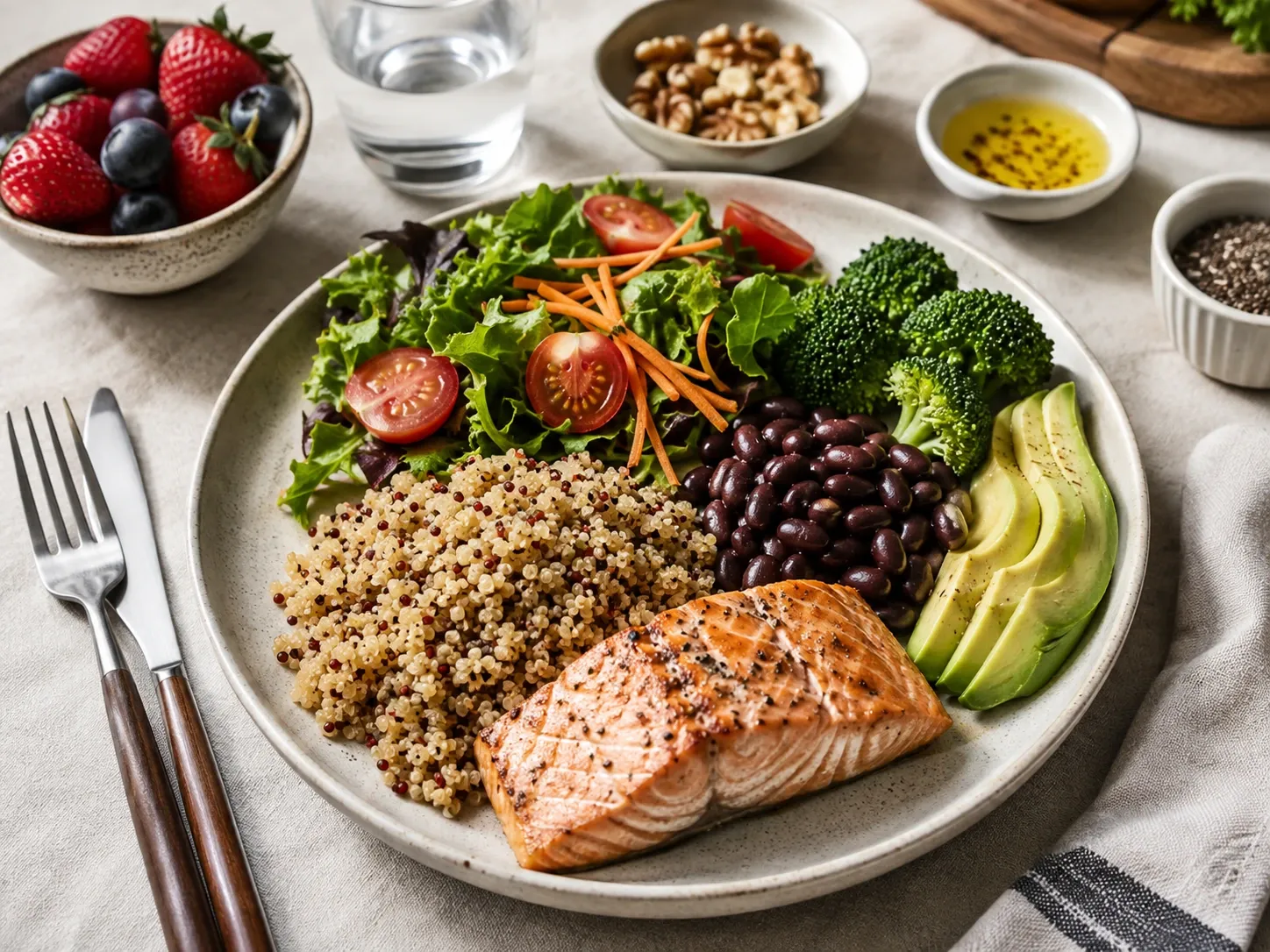
Intermittent fasting does not automatically turn a nutritionally poor diet into a healthy one.
The World Health Organization identifies adequacy, balance, moderation, and diversity as core principles of healthy eating and emphasizes a foundation of minimally processed or unprocessed foods. (WHO)
A practical eating window therefore still needs to provide enough opportunities to meet nutritional needs.
Depending on individual requirements, that may involve:
- adequate protein sources;
- fruits and vegetables;
- legumes;
- whole grains;
- appropriate sources of unsaturated fats;
- sufficient fluids;
- enough dietary variety to provide essential micronutrients.
If fasting consistently triggers overeating, poor nutrient intake, or an excessively rigid relationship with food, it may not be the most sustainable approach.
Is there an ideal fasting schedule?
Not at present.
Studies have examined different eating windows, alternate-day fasting, periodic restriction, and other approaches. Although individual differences between protocols have been reported, current evidence does not support a universal rule that every adult should fast for exactly 14, 16, 18, or more hours per day. (BMJ)
For long-term weight management, the NIDDK emphasizes choosing a healthy eating plan that can be maintained over time. (NIDDK)
Before choosing a fasting schedule, it may be more useful to ask:
- Can I follow this schedule most days?
- Does it fit my work, sleep, exercise, and social life?
- Can I still eat nutritionally adequate meals?
- Does fasting comfortably reduce my intake, or does it trigger compensation later?
- Can I realistically imagine following this pattern six months from now?
A theoretically optimal diet has little practical value if it is quickly abandoned.
Who should be cautious?
Intermittent fasting should not be started indiscriminately.
People using insulin or medicines that can cause hypoglycemia should discuss major changes in meal timing with their healthcare professional. Continuing certain glucose-lowering treatments while fasting can increase the risk of low blood glucose. (NIDDK)
NIDDK guidance also highlights caution for people with a history of eating disorders and during pregnancy. Older adults who are particularly vulnerable to loss of lean mass may also benefit from individualized assessment. (NIDDK)
Is the best fasting plan the one you can maintain?

That is a useful way to interpret much of the current evidence.
Intermittent fasting provides one simple rule: control when you eat. Conventional diets may focus more directly on how much and what you eat.
Neither strategy eliminates the need for consistency.
Sustainable weight-management plans also need to account for overall diet quality, physical activity, behavioral habits, and long-term maintenance. NIDDK guidance specifically emphasizes choosing a healthy eating plan that can be maintained over time. (NIDDK)
For someone who naturally prefers skipping an early breakfast and finishing dinner at a consistent time, a defined eating window may simplify the process.
For someone who wakes up hungry, exercises early, or frequently has evening social commitments, rigid fasting hours may make adherence harder.
Different methods can therefore lead to similar outcomes when they help different people maintain sustainable dietary changes.
Conclusion
Intermittent fasting can work for weight loss, but it is not a magic formula.
Current evidence shows that fasting can reduce body weight and can be a practical alternative to conventional calorie restriction. When the approaches are directly compared, however, the differences are generally small or absent. (Cochrane Library)
Alternate-day fasting showed a modest advantage in one large network meta-analysis, but this does not establish the superiority of intermittent fasting as a whole. (PubMed)
Rather than searching for a perfect number of fasting hours, it is more useful to consider whether the approach makes healthy eating easier, produces an appropriate reduction in energy intake when needed, and can be maintained without harming health or someone’s relationship with food.
For sustainable weight management, adherence, dietary quality, and consistency remain central. (WHO)