Does Ginger Help With Nausea, Digestion, and Inflammation?
Ginger may help certain types of nausea and can affect gastric motility and inflammatory markers. Learn where the evidence is strongest and where uncertainty remains.
Few foods have accumulated as many health claims as ginger. It is commonly recommended for nausea, indigestion, bloating, inflammation, and a wide range of other complaints, often without distinguishing traditional use from clinical evidence.
Human research presents a more specific picture: ginger has reasonable evidence for certain forms of nausea, particularly during pregnancy; there is evidence that it can affect stomach motility; and supplementation may alter some inflammatory biomarkers. These effects, however, are not equally well established. (NCCIH)
What Is Ginger?
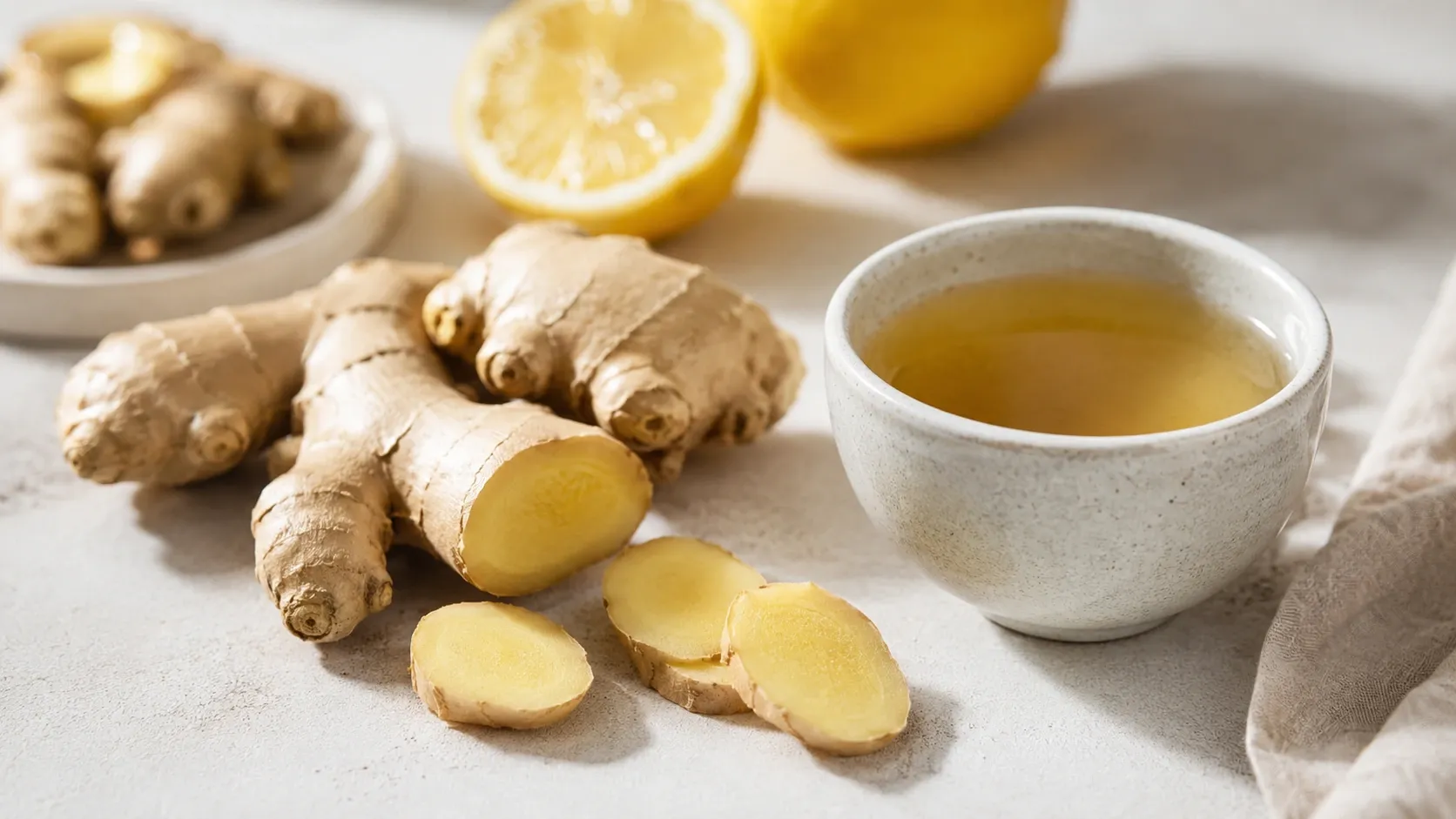
Ginger comes from the rhizome of Zingiber officinale. Although commonly called ginger root, the edible portion is botanically an underground stem, or rhizome. (NCCIH)
It can be eaten fresh or dried and is also sold as powder, tea, capsules, and concentrated extracts.
That distinction matters when interpreting health research. The NCCIH notes that most studies evaluating ginger for nausea have tested dietary supplements rather than ginger as a food. (NCCIH)
A finding obtained with a controlled-dose extract should therefore not automatically be attributed to every cup of ginger tea.
Does Ginger Really Work for Nausea?

Nausea is one of the best-known uses of ginger, but it does not have a single cause.
Pregnancy, chemotherapy, surgery, motion sickness, infections, medications, and gastrointestinal disorders can all trigger nausea through different mechanisms.
Evidence for ginger varies accordingly.
| Situation | What current evidence suggests |
|---|---|
| Pregnancy-related nausea | Possible benefit |
| Pregnancy-related vomiting | Less consistent than nausea |
| Motion sickness | Most studies show no clear benefit |
| Chemotherapy-related nausea | Mixed evidence; possible adjunct only |
| Postoperative nausea | Evidence remains uncertain |
| Unexplained nausea | Evidence cannot be generalized |
The NCCIH concludes that ginger may help pregnancy-related nausea and vomiting. In contrast, most motion-sickness studies have not shown it to be helpful, and its usefulness as an addition to standard chemotherapy or postoperative anti-nausea care remains uncertain. (NCCIH)
Ginger and Morning Sickness
A meta-analysis comparing ginger with placebo and vitamin B6 found improvement in overall pregnancy-related nausea and vomiting symptoms and a significant reduction in nausea versus placebo. The isolated effect on vomiting was not significant. (PubMed)
A more recent evidence scan examining ginger during pregnancy identified several meta-analyses, but also found substantial overlap among the individual studies included in those reviews. In other words, multiple meta-analyses do not necessarily represent entirely independent bodies of evidence. (PubMed)
The most appropriate conclusion is therefore that ginger may reduce the severity of nausea in some pregnant people, rather than that it reliably eliminates morning sickness.
What About Chemotherapy-Induced Nausea?
The evidence is more complicated.
A 2022 systematic review did not confirm a consistent reduction in chemotherapy-induced nausea or delayed vomiting, although some subgroup analyses suggested a possible reduction in acute vomiting. (MDPI)
Some newer studies have continued to report potentially favorable outcomes in specific regimens, but the NCCIH still describes the evidence for adding ginger to standard chemotherapy-related nausea treatment as uncertain. (PubMed)
Most importantly, ginger is not a replacement for prescribed antiemetic medication during cancer treatment.
Does Ginger Prevent Motion Sickness?
This is an area where popular reputation exceeds the clinical evidence.
According to the NCCIH, most studies of ginger for motion sickness have not shown it to be helpful. (NCCIH)
It is therefore not evidence-based to promise that ginger candy, tea, or capsules will reliably prevent nausea during travel.
Does Ginger Improve Digestion?

The answer depends on what “improve digestion” means.
It might refer to:
- reducing uncomfortable fullness;
- improving early satiety;
- speeding stomach emptying;
- decreasing upper-abdominal pain;
- relieving bloating;
- treating functional dyspepsia.
These are separate outcomes.
One notable randomized study investigated people with functional dyspepsia. A dose of 1.2 g of ginger accelerated gastric emptying and stimulated antral contractions, but these physiological changes did not improve gastrointestinal symptoms in that trial. (PubMed)
That distinction is important: changing a physiological measurement does not necessarily mean that a person feels better.
Can Ginger Speed Up Gastric Emptying?
Possibly, although findings are not completely uniform.
The functional-dyspepsia study found faster gastric emptying, and an earlier experiment in healthy volunteers also reported faster emptying and greater antral contractions. (PubMed)
However, an older randomized crossover trial involving 16 healthy volunteers found no effect of 1 g of ginger on gastric emptying. (PubMed)
This is one reason why the popular statement that ginger simply “speeds up digestion” is too broad.
Can It Reduce Indigestion Symptoms?
There are promising findings, but the evidence is not yet strong.
A 2023 study followed 51 people with functional dyspepsia for four weeks of ginger supplementation and reported improvements in post-meal fullness, early satiety, epigastric pain, and burning. (PubMed)
However, the study used a before-and-after design rather than a parallel placebo group. This makes it difficult to determine how much of the improvement resulted specifically from ginger.
Another randomized trial reported improvement in functional dyspepsia using a combination of ginger and artichoke extracts, meaning the effect cannot be attributed to ginger alone. (PubMed)
Overall, ginger is worth investigating for digestive symptoms, but the current evidence does not justify presenting it as a proven general treatment for indigestion.
Is Ginger Anti-Inflammatory?
This claim requires careful interpretation.
There is a difference between:
- containing biologically active compounds;
- changing inflammatory biomarkers;
- treating an inflammatory disease.
These are not interchangeable claims.
A systematic review and meta-analysis of randomized controlled trials found significant reductions in CRP, high-sensitivity CRP, and TNF-α with ginger supplementation. IL-6 and sICAM, however, were not significantly changed. (PubMed)
This supports the possibility that ginger can influence some pathways related to inflammation.
It does not prove that ginger can independently treat inflammatory diseases.
Lower Biomarkers Do Not Automatically Mean a Disease Has Been Treated
CRP, TNF-α, and IL-6 are laboratory markers researchers use to investigate inflammatory processes.
A useful clinical treatment, however, generally needs evidence for outcomes that matter directly to patients, such as symptoms, physical function, disease progression, or complications.
An umbrella review of oral ginger research rated evidence for anti-inflammatory and antioxidant biomarkers from very low to moderate quality, with the magnitude of effect remaining unclear. (Bond University Research Portal)
A scientifically appropriate conclusion is therefore:
ginger has potential anti-inflammatory activity and may affect certain biomarkers, but it should not be considered a substitute for established treatment of inflammatory diseases.
Which Compounds in Ginger Are Studied?
Ginger contains a variety of bioactive compounds, including gingerols and shogaols, which are frequently investigated for potential effects on inflammatory signaling, oxidative processes, and gastrointestinal function. (PubMed)
Their concentration can vary with:
- plant variety;
- drying and processing;
- heating;
- storage;
- extraction method;
- whether ginger is fresh or dried.
Consequently, fresh ginger, powdered ginger, an extract, and a cup of tea are not necessarily pharmacologically equivalent.
Does Ginger Tea Have the Same Effects as Supplements?
There is not enough evidence to say that it does.
Many clinical trials use dry ginger powder, capsules, or standardized extracts. The NCCIH specifically notes that most nausea research has evaluated dietary supplements rather than ginger consumed as food. (NCCIH)
The quantity of ginger-related compounds in tea will vary according to how much ginger is used, preparation method, temperature, and infusion time.
Ginger tea can certainly be part of a normal diet, but claims such as “one cup of ginger tea reduces inflammation” go beyond what the clinical evidence establishes.
How Much Ginger Has Been Studied?
There is no single research dose for every purpose.
Clinical reviews frequently report approximately 0.5–1.5 g per day in nausea studies, although both lower and higher amounts have been tested depending on the formulation and condition. (MDPI)
The functional-dyspepsia gastric-motility study used 1.2 g of ginger before the test meal. (WJGNet)
These figures describe study protocols, not personalized treatment recommendations.
Importantly, 1 g of dried ginger powder is not necessarily equivalent to 1 g of a concentrated extract, nor is there a universal conversion between fresh ginger, tea, and capsules.
Is Ginger Safe?
Normal culinary use and concentrated supplementation represent different levels of exposure.
The NCCIH reports that oral ginger has been used safely in many clinical studies, but potential side effects include:
- abdominal discomfort;
- heartburn;
- diarrhea;
- irritation of the mouth and throat. (NCCIH)
People taking medication should discuss regular use of concentrated herbal products with a healthcare professional because herbal products and medicines can interact. (NCCIH)
Pregnancy also deserves particular caution when supplements are being considered. (NCCIH)
When Should Nausea or Digestive Symptoms Be Evaluated?
Persistent or severe symptoms should not simply be masked with ginger.
Repeated vomiting, signs of dehydration, blood in vomit or stool, unexplained weight loss, severe pain, difficulty swallowing, or persistent digestive symptoms warrant professional medical evaluation.
Likewise, people with diagnosed inflammatory diseases should not discontinue prescribed medication in favor of ginger, tea, or supplements.
Is Ginger Worth Including in Your Diet?
For most people who tolerate it, ginger can be used as a culinary ingredient to add flavor and aroma to meals and drinks.
Therapeutic claims require a different standard.
The strongest evidence is for pregnancy-related nausea, although supplemental use during pregnancy should still be discussed with a healthcare professional. (NCCIH)
For digestion, there are interesting findings related to gastric motility and some preliminary symptom data, but the evidence remains limited. (PubMed)
For inflammation, clinical studies suggest changes in selected biomarkers, but the evidence does not support treating ginger as a universal therapy for inflammatory disease. (PubMed)
Conclusion
Ginger does produce measurable effects in humans, but its usefulness depends on the specific goal.
The evidence for nausea is strongest in pregnancy and substantially less consistent for motion sickness, chemotherapy, and postoperative nausea. (NCCIH)
For digestion, ginger may accelerate gastric emptying in some settings, but physiological changes have not consistently translated into symptom relief. (PubMed)
For inflammation, supplementation can reduce certain blood biomarkers, but the quality of evidence varies and this is not equivalent to proving that ginger treats inflammatory disease. (PubMed)
Ginger is therefore best described as an interesting food with a few promising and partially supported clinical applications—not as a universal digestive remedy or natural anti-inflammatory drug.