Does Fish Oil Work? What to Know Before Choosing a Supplement
Fish oil provides EPA and DHA, but its benefits depend on the dose, formulation and purpose. Learn what the evidence shows and what to check on the label.

Fish oil capsules are among the most familiar omega-3 supplements. They are promoted for everything from heart health to brain function, yet the scientific evidence is much stronger for some claims than for others.
The short answer is that fish oil can work, but the benefit depends on the goal, dose, formulation and person taking it. Lowering triglycerides is among its best-established effects. The idea that every healthy adult should take fish oil every day to prevent cardiovascular disease is much less certain. (ODS)
Understanding that distinction also makes supplement labels much easier to evaluate.
What is in fish oil?
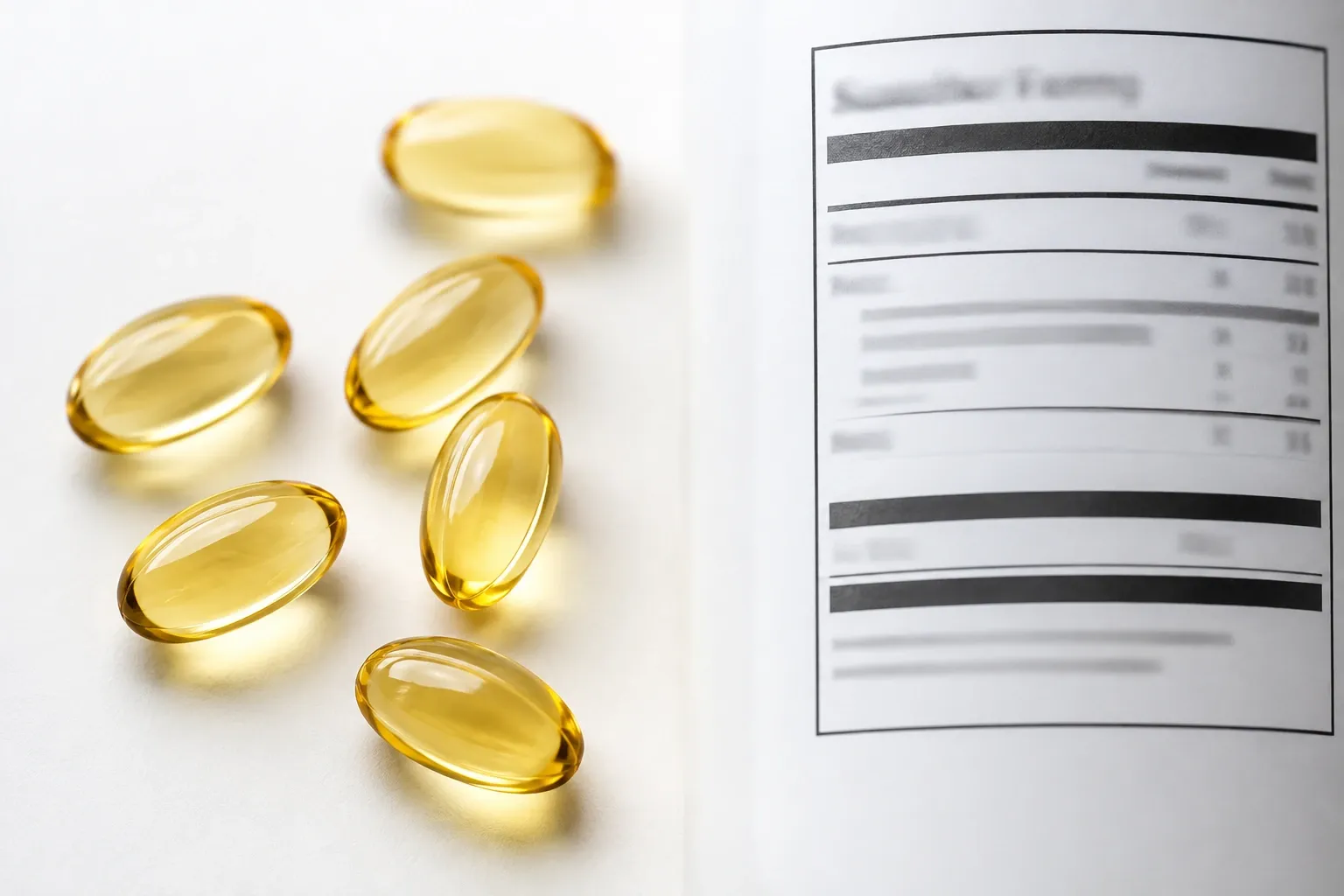
The two major long-chain omega-3 fatty acids of interest are:
- EPA, or eicosapentaenoic acid;
- DHA, or docosahexaenoic acid.
Fish and seafood contain EPA and DHA, and fish oil supplements provide them in varying amounts and ratios. Algal supplements can also provide these long-chain omega-3s without using fish. (ODS)
The important point is that the amount of fish oil is not the same as the amount of EPA and DHA.
1,000 mg of fish oil does not mean 1,000 mg of EPA and DHA
This is one of the most useful details to understand when comparing products.
The NIH gives a typical example of about 1,000 mg of fish oil providing roughly 180 mg EPA and 120 mg DHA, or 300 mg of the two combined. Actual formulations vary widely. (ODS)
A label could therefore look like this:
| Label information | Example |
|---|---|
| Fish oil | 1,000 mg |
| EPA | 180 mg |
| DHA | 120 mg |
| EPA + DHA | 300 mg |
This example is not a recommended dose. It simply illustrates why the total milligrams of oil should not be mistaken for the amount of the omega-3 fatty acids most extensively studied.
Does fish oil lower triglycerides?
This is where the evidence is strongest.
EPA and DHA can lower blood triglyceride levels. For people with high triglycerides, the American Heart Association has concluded that 4 g/day of prescription omega-3 fatty acids, containing EPA plus DHA or EPA alone, can effectively lower triglycerides. (ODS)
The word prescription matters.
A therapeutic dose used to manage hypertriglyceridemia is not a general recommendation to take several over-the-counter capsules each day.
What about preventing heart attacks and cardiovascular disease?
The answer is more complicated.
A 2021 meta-analysis of 38 randomized trials found reductions in some cardiovascular outcomes with omega-3 interventions, with stronger effects in trials using EPA alone. Other large systematic assessments, however, have found little or no effect from increasing EPA and DHA on mortality and several cardiovascular outcomes. (PubMed)
An updated 2025 review emphasized that outcomes vary with dose, formulation and patient characteristics. (PubMed Central (PMC))
That makes statements such as “omega-3 prevents heart attacks” too simplistic.
A pharmaceutical purified-EPA treatment studied in selected high-risk patients is not equivalent to a standard low-dose fish oil capsule containing both EPA and DHA.
The FDA has also allowed certain qualified claims involving EPA, DHA, blood pressure and coronary heart disease while explicitly stating that the supporting evidence for those claims is inconsistent and inconclusive. (FDA)
Who might benefit from supplementation?
That depends primarily on the reason for taking it.
Someone who eats little or no fish may use a supplement as a practical source of EPA and DHA. People with elevated triglycerides may receive specific omega-3 formulations as part of medical treatment. (ODS)
Neither situation means that every healthy adult needs a fish oil supplement.
Useful questions include:
- How much fish and seafood do you normally eat?
- What is the goal of supplementation?
- How much EPA and DHA does the product provide?
- Do you have elevated triglycerides?
- Do you have cardiovascular disease or arrhythmias?
- Are you taking prescription medications?
A more useful question than “Is omega-3 good for you?” is “Good for what, at what dose and for whom?”
How to choose a fish oil supplement

1. Look at EPA and DHA first
Turn the bottle around and read the nutrition or supplement panel.
Find the milligrams of EPA and DHA in the daily serving, then add the two together.
This gives you a much more meaningful comparison than the total amount of fish oil printed on the front of the bottle. (ODS)
2. Check the actual serving size
A large number on the front label may refer to two, three or even more capsules.
Before comparing concentration or price, check:
- capsules per serving;
- EPA per serving;
- DHA per serving;
- total EPA + DHA;
- number of servings per bottle.
This also makes it easier to compare the actual cost per amount of EPA and DHA.
3. Match the concentration to the purpose
A more concentrated supplement can provide more EPA and DHA with fewer capsules, but higher intake is not automatically better.
Therapeutic doses have specific indications. A nutritional supplement used to increase dietary EPA and DHA is a different situation from treatment for high triglycerides. (ODS)
4. Do not confuse a supplement with an omega-3 prescription drug
Some of the best-known cardiovascular trial results involved highly specific pharmaceutical formulations.
It is therefore inappropriate to assume that any over-the-counter product labeled “fish oil” will reproduce the same clinical outcomes.
Dose, EPA/DHA ratio, formulation and patient population all matter. (PubMed)
5. Consider manufacturing and quality controls
Brazil’s Anvisa advises consumers to purchase supplements from reliable stores or websites, follow recommended use and seek professional advice when appropriate. (Serviços e Informações do Brasil)
Independent quality-testing programs can offer an additional level of assurance regarding identity, label accuracy and contaminants. Such verification does not, however, prove that the supplement will be clinically effective for a particular condition. (ODS)
6. Check for additional ingredients
Not every omega-3 product contains only fish oil.
Cod liver oil, for example, can contain vitamins A and D as well as EPA and DHA. It therefore has a different nutritional and safety profile from a conventional fish oil concentrate. (ODS)
This matters particularly for anyone already taking multivitamins or other fat-soluble vitamin supplements.
7. Be cautious with broad health promises
Claims such as:
- “completely protects your heart”;
- “prevents heart attacks”;
- “eliminates inflammation”;
- “guarantees better memory”;
go beyond what can reasonably be concluded for an ordinary fish oil supplement.
Even within cardiovascular research, outcomes are not uniform. (FDA)
Is a higher omega-3 dose better?
Not necessarily.
The NIH notes that supplements providing no more than 5 g/day of EPA and DHA are considered safe when used as recommended, but a safety threshold is not a recommended target. High-dose trials have also raised concerns about atrial fibrillation in some populations. (ODS)
A 2025 review of randomized trials found a higher relative occurrence of atrial fibrillation among participants treated with EPA and/or DHA, although the absolute difference was small and the dose and cardiovascular-risk context matter. (PubMed)
Taking several grams per day without a clear indication is therefore not a sensible “more is better” strategy.
Does fish oil increase bleeding risk?
Omega-3 fatty acids can influence platelet-related processes, which is why interactions with anticoagulants are frequently discussed.
However, evidence summarized by the NIH indicates that fish oil doses of 3–6 g/day generally did not significantly alter anticoagulation status in people taking warfarin. People using anticoagulants should still discuss supplements and high-dose omega-3 use with their healthcare professional. (ODS)
Healthcare teams should also know which supplements a patient takes before procedures or surgery.
Fish or capsules?

Supplements can provide EPA and DHA, but they do not reproduce an entire food.
Fish also provides protein and multiple micronutrients and can replace other foods within an overall healthy dietary pattern. Evidence related to eating seafood as part of a healthy diet is therefore not identical to evidence from trials of fish oil capsules. (ODS)
Taking a supplement cannot compensate for an otherwise poor-quality diet.
Fish oil buying checklist
Before choosing a product, check:
- How much EPA does one serving provide?
- How much DHA does one serving provide?
- What is the total EPA + DHA?
- How many capsules make up one serving?
- Are other nutrients included?
- Is the seller reputable?
- Are the manufacturer and batch information clearly identified?
- Is independent quality verification available?
- Does the dose match the intended purpose?
- Do medications or health conditions warrant professional guidance?
Conclusion
Fish oil is neither useless nor a universal cardiovascular insurance policy.
Its evidence is particularly strong for lowering triglycerides when appropriate formulations and doses are used, while broader cardiovascular benefits depend considerably on the population, dose and formulation being studied. (ODS)
When comparing supplements, look beyond the marketing on the front of the bottle. EPA + DHA per serving, intended dose, product quality and provenance are more informative than the total milligrams of fish oil.
If the goal is to treat elevated triglycerides, use high doses or combine omega-3 with prescription medications, supplementation should become a clinical decision rather than simply a shopping decision.