How Many Steps a Day Do We Really Need for Better Health?
You don't necessarily need 10,000 steps a day. Learn what research says about 4,000, 7,000 and 10,000 daily steps and how to choose a realistic target.

10,000 steps a day has become one of the best-known targets in fitness. Smartwatches and phone apps routinely display step goals, progress rings and reminders designed to keep people moving until they hit a particular number.
But there is good news if your average day ends at 5,000, 6,000 or 7,000 steps: the health benefits of walking do not suddenly begin at 10,000.
A major 2025 systematic review and dose-response meta-analysis published in The Lancet Public Health found that around 7,000 daily steps was associated with meaningful improvements across several health outcomes. For a number of outcomes, much of the observed risk reduction occurred before 10,000 steps. (thelancet.com)
That does not make 7,000 a new magic number. The more useful message is simpler: if you currently move very little, moving more already matters.
So how many steps per day do we need?

There is no exact number that applies to every adult.
A practical interpretation of current research looks something like this:
| Daily steps | Practical interpretation |
|---|---|
| Below 4,000 | Increasing your usual level may already be worthwhile if you are highly inactive |
| Around 4,000–6,000 | Can represent a substantial improvement over very low activity |
| Around 7,000 | A realistic target supported by strong recent observational evidence |
| 8,000–10,000+ | May provide additional benefits and remains an appropriate goal for people who can comfortably achieve it |
These are not clinical prescriptions or rigid thresholds. They are a simplified interpretation of population-level dose-response patterns. (The Lancet)
What did the latest research find about 7,000 steps?
The 2025 review included 57 studies from 35 cohorts, with 31 studies from 24 cohorts contributing to meta-analyses. It examined outcomes far beyond mortality alone, including cardiovascular disease, diabetes, dementia, mental health and falls. (thelancet.com)
Compared with approximately 2,000 daily steps, 7,000 steps was associated with:
| Outcome | Association at 7,000 vs. 2,000 steps/day |
|---|---|
| All-cause mortality | 47% lower risk |
| Cardiovascular disease incidence | 25% lower risk |
| Cardiovascular mortality | 47% lower risk |
| Type 2 diabetes | 14% lower risk |
| Dementia | 38% lower risk |
| Depressive symptoms | 22% lower risk |
| Falls | 28% lower risk |
| Cancer mortality | 37% lower risk |
For cancer incidence, the estimated 6% reduction was not statistically significant in that comparison. (PubMed)
These figures should not be interpreted as guarantees for an individual. They describe associations observed across populations, and most step-count evidence comes from observational research. (thelancet.com)
Do we really need 10,000 steps?
No.
A 2022 meta-analysis in The Lancet Public Health already noted that although 10,000 steps was widely promoted, there was little evidence supporting it as a specific threshold required for health benefits. (PubMed)
The analysis included 47,471 adults and found progressively lower mortality risk as daily steps increased, with the curve beginning to level off at different ranges depending on age:
| Age | Approximate range where mortality benefit began to level off |
|---|---|
| 60 years and older | 6,000–8,000 steps/day |
| Younger than 60 | 8,000–10,000 steps/day |
(PubMed)
This does not mean 11,000 or 12,000 steps are harmful. It simply suggests that the additional reduction in mortality risk becomes smaller after certain ranges.
If you naturally reach 10,000 steps and enjoy doing so, there is no reason to stop at 7,000. The problem is treating 10,000 as an all-or-nothing cutoff.
Benefits can begin much earlier

For people who are highly inactive, one of the most encouraging findings is that they do not need to reach a high target immediately.
A 2024 prospective study of 72,174 UK Biobank participants found that any step count above a reference of approximately 2,200 steps per day was associated with lower mortality and cardiovascular disease risk. Around 4,000–4,500 daily steps represented roughly half of the maximum observed association for those outcomes. (British Journal of Sports Medicine)
The lowest risks in that particular study occurred at higher step counts—around 9,000–10,500 for mortality and roughly 9,700 for cardiovascular disease. (British Journal of Sports Medicine)
That is why 7,000 and 10,000 should not be seen as competing recommendations.
Someone averaging 2,500 steps may first aim for 3,500 or 4,000, then gradually increase as their routine, health and fitness allow.
Does age change the ideal step count?
Age appears to influence the dose-response relationship, although there is no definitive step prescription for every age group.
The 2022 meta-analysis found that adults aged 60 and older experienced progressively lower mortality risk up to approximately 6,000–8,000 steps per day, whereas adults younger than 60 continued to show reductions closer to 8,000–10,000 steps. (PubMed)
For older adults, particularly those with limited mobility, impaired balance or chronic health conditions, individualized goals are often more useful than copying a number from a fitness app.
WHO guidelines also recommend that older adults include multicomponent physical activity emphasizing strength and balance to support functional capacity and help prevent falls. (WHO)
Does walking speed matter?
Total step volume matters substantially.
In the 2022 meta-analysis, higher daily step counts showed a clear association with lower mortality. Some measures of stepping rate were also associated with risk, although several associations became weaker after researchers accounted for total step volume. (PubMed)
This means everyday movement still counts.
Walking to work, shopping, taking the dog out, moving around the house and other daily activities can all contribute to your step total.
However, intensity remains relevant for cardiorespiratory fitness and for meeting official aerobic activity guidelines. Brisk walking can qualify as moderate-intensity activity and contribute toward the recommended weekly exercise target. (CDC)
A useful strategy is therefore to combine both ideas:
move more throughout the day, and make some of that movement brisk when appropriate.
Do step counts replace the 150-minute exercise recommendation?

Not completely.
Step counting is easy and useful, but it does not capture every dimension of physical activity.
WHO recommends that adults perform 150–300 minutes of moderate-intensity aerobic activity per week, or 75–150 minutes of vigorous activity, or an equivalent combination. Muscle-strengthening activities are also recommended on at least two days per week. (WHO)
The CDC similarly recommends at least 150 minutes of moderate-intensity activity each week plus muscle-strengthening activities on at least two days. (CDC)
Step trackers do not adequately capture activities such as:
- resistance training;
- cycling;
- swimming;
- rowing;
- some machine-based workouts.
Someone can therefore have a relatively low step count on a day that includes an excellent cycling or strength-training session.
Steps are a useful metric, but they are not a complete definition of physical activity.
Can more steps offset a sedentary day?
They help, but that does not make prolonged sitting irrelevant.
The 2024 UK Biobank study found that higher daily step counts were associated with lower mortality and cardiovascular disease risk among people with both high and low sedentary time. However, for roughly the same number of steps, cardiovascular risk was lower among those with less sedentary time. (British Journal of Sports Medicine)
The practical message is twofold:
walk more, including if you have a desk-based job, and reduce long uninterrupted periods of sitting when possible.
WHO guidance recommends limiting sedentary behavior and replacing sedentary time with physical activity where possible. (WHO)
What about mental health?
Available evidence suggests a favorable association, although it remains largely observational.
A 2024 systematic review and meta-analysis published in JAMA Network Open included 33 observational studies involving 96,173 adults and found that higher objectively measured daily step counts were associated with fewer depressive symptoms. The researchers noted that additional prospective research is still needed. (PubMed)
The 2025 review similarly found that 7,000 daily steps was associated with a 22% lower risk of depressive symptoms compared with 2,000 steps. (PubMed)
Walking should not be presented as a replacement for appropriate assessment or treatment of depression. Physical activity can support mental health, but depressive disorders require appropriate care according to individual circumstances.
How should you set a realistic step goal?
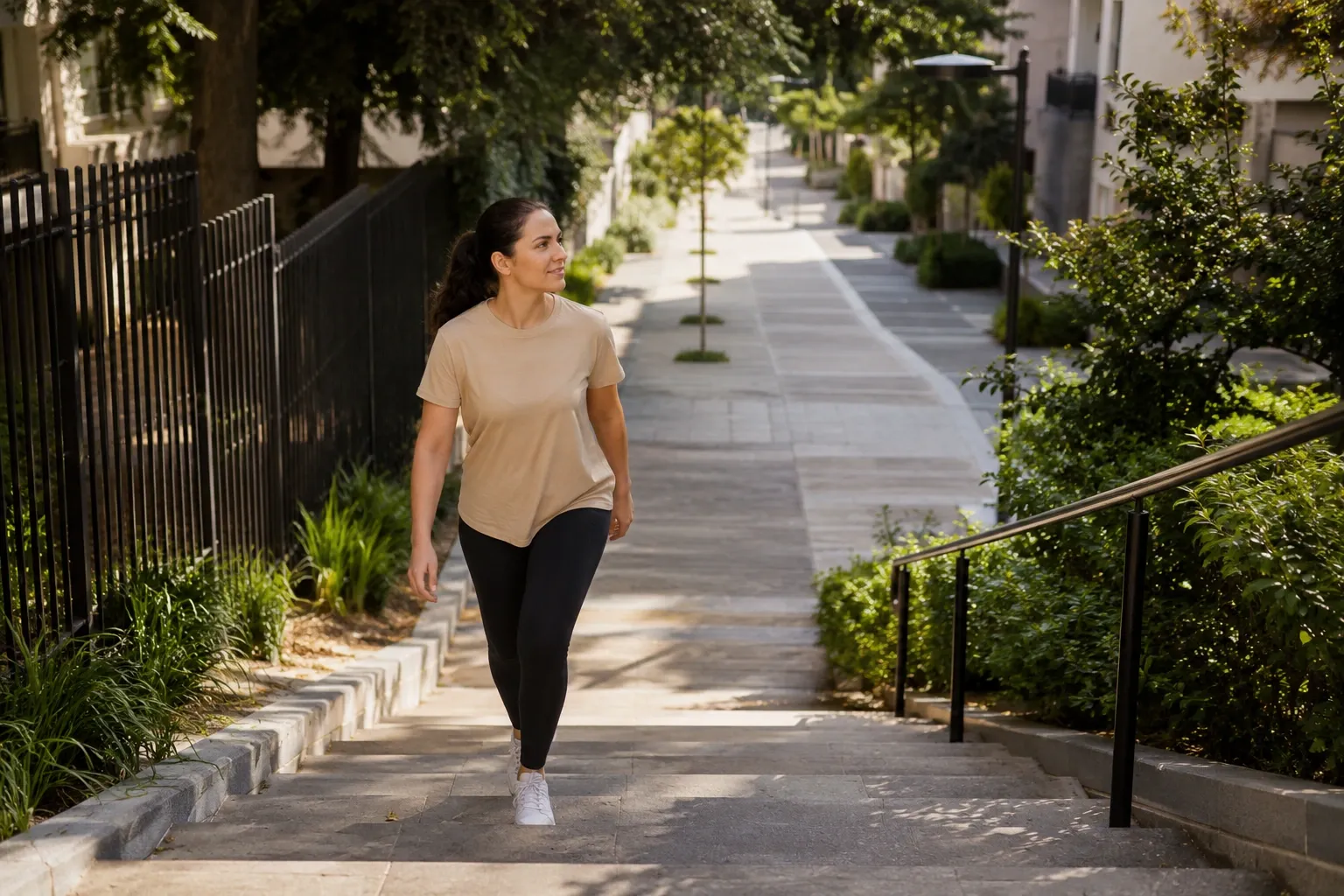
Start by checking your current average rather than choosing 7,000 or 10,000 immediately.
If your phone or watch shows an average of 3,000 daily steps, suddenly aiming for 10,000 may require a very large lifestyle change.
A more sustainable strategy is to increase gradually.
Someone averaging 3,000 steps might first aim for 4,000. Once that feels normal, they could try 5,000 and continue progressing according to their health, schedule and goals.
Simple ways to add movement include taking a short walk after a meal, walking part of a regular commute, getting up during long periods of desk work, choosing stairs when appropriate and adding a few minutes to an existing walk.
Consistency matters more than making every day perfect.
What if I cannot reach 7,000 steps?
Walking fewer than 7,000 steps is not pointless.
This may be the most important takeaway from the evidence.
If you currently average 2,000 steps, moving toward 3,000 or 4,000 may be much more useful than remaining inactive because 7,000 feels unattainable. Recent studies consistently show a graded relationship between step count and health rather than a strict threshold. (British Journal of Sports Medicine)
People with cardiovascular disease, substantial mobility limitations, symptoms during exertion, recent surgery or other significant health conditions should discuss major changes in activity with a qualified healthcare professional.
Conclusion
You do not necessarily need 10,000 steps per day to gain health benefits.
Current evidence suggests meaningful improvements at lower levels, particularly when someone begins from a very inactive baseline. A major 2025 review supports around 7,000 daily steps as a realistic, evidence-informed target for many adults, but it should not become another rigid or universal cutoff. (thelancet.com)
For older adults, important benefits may occur at lower ranges, while younger and more active adults may continue to see gains at higher step counts. (PubMed)
The most useful goal is therefore not to make the step counter a pass-or-fail test.
Move more than you do now, reduce prolonged sitting, include some moderate-intensity activity and remember that strength training remains part of a complete physical activity routine. (WHO)