Can Too Little Sleep Increase Hunger and Make Weight Loss Harder?
Too little sleep may increase calorie intake and make weight management harder. Learn what research says about sleep, hunger, appetite and weight loss.

After a short night, some people notice more snacking, stronger interest in highly palatable foods or greater difficulty sticking to their usual eating plan. Research suggests there may be a biological and behavioral basis for this experience: experimental sleep restriction can promote higher energy intake. (JAMA Network)
The explanation, however, is more complicated than saying that lack of sleep simply increases a “hunger hormone.” Current evidence suggests that hunger, hormonal signaling, food reward, time available to eat and other factors may all play a role—and they do not respond identically in everyone. (Wiley Online Library)
Adequate sleep is therefore best considered one component of healthy weight management. It does not replace nutrition or physical activity, but overlooking chronically poor sleep may make weight management more difficult for some people. (Instituto Nacional de Diabetes e Doenças Digestivas e Renais)
What happens to appetite when you do not sleep enough?
Human eating behavior is controlled by much more than one hormone.
Hunger, satiety, habits, emotions, food availability, reward, meal timing and metabolic signaling all influence when and how much we eat.
A 2026 review in the Journal of Sleep Research examined randomized controlled research on sleep restriction, appetite, motivation to eat and dietary intake. The findings were mixed. Some experiments found greater hunger or food motivation after restricted sleep, while others did not. Importantly, some studies reported increased food intake without a matching increase in measured appetite. (Wiley Online Library)
This suggests that people may sometimes eat more after insufficient sleep without necessarily feeling dramatically hungrier.
What about ghrelin and leptin?
Ghrelin and leptin are commonly used to explain the relationship between sleep and appetite.
Ghrelin participates in signals related to hunger and meal initiation, while leptin contributes to longer-term regulation of energy availability.
Some experimental studies have reported higher ghrelin, lower leptin and greater hunger after sleep restriction. A later meta-analysis of acute sleep deprivation also identified changes in appetite-related hormones, while noting differences according to participant characteristics such as sex and body weight. (PubMed)
The current evidence therefore does not justify a universal equation in which every short night automatically causes the same hormonal response.
Can insufficient sleep make you eat more calories?
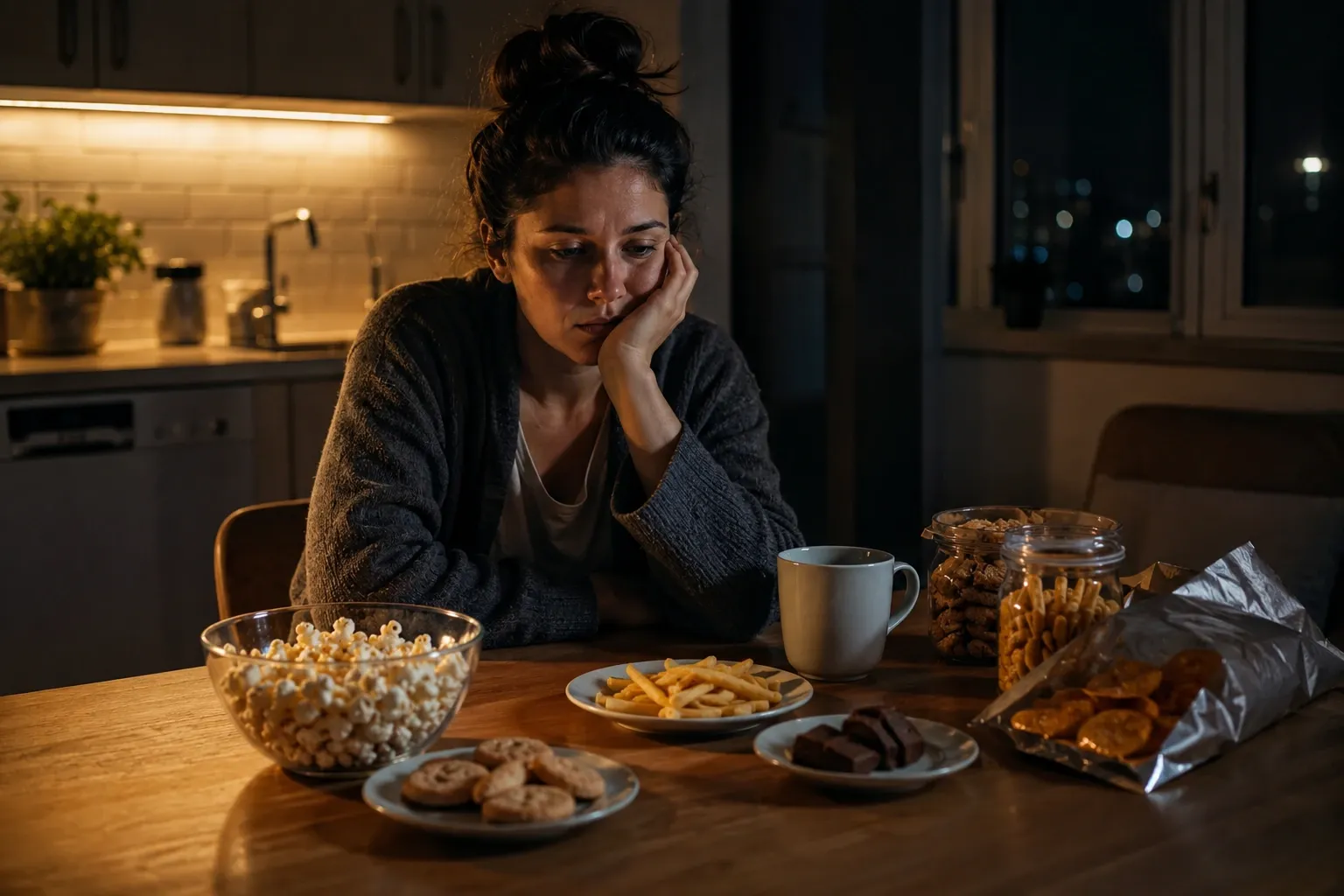
Controlled experiments provide evidence that it can.
In a 2022 study, healthy adults completed both adequate-sleep and restricted-sleep conditions. During the restricted period, participants had a four-hour sleep opportunity for 14 days and unrestricted access to food. (ResearchGate)
They consumed more calories during sleep restriction without a corresponding increase in energy expenditure and gained more weight. Abdominal fat, including visceral fat, also increased during the sleep-restricted condition. (ResearchGate)
The study was small and used a substantial degree of sleep restriction, so its findings should not be interpreted as evidence that occasionally sleeping one hour less will produce the same outcome.
It does, however, provide experimental evidence that insufficient sleep can influence energy balance.
What happens when habitual short sleepers get more sleep?

Researchers have also tested the opposite approach.
A randomized clinical trial published in JAMA Internal Medicine included 80 adults with overweight who habitually slept less than 6.5 hours per night. Participants continued their normal lives and were not given a prescribed diet or exercise program. (JAMA Network)
Those assigned to individualized sleep-extension counseling increased their sleep duration by approximately 1.2 hours per night.
Compared with controls, their estimated daily energy intake decreased by about 270 calories per day, while total energy expenditure did not differ significantly between groups. (JAMA Network)
| Outcome | Sleep extension |
|---|---|
| Average increase in sleep | ~1.2 hours/night |
| Difference in energy intake | −270 kcal/day |
| Significant difference in total energy expenditure | No |
These findings are encouraging, but the intervention was short and involved a specific group of adults with overweight and habitual short sleep.
The trial does not establish that the same calorie reduction would persist for months or years. (JAMA Network)
Does sleeping more make you lose weight?
Not necessarily.
A 2026 systematic review, meta-analysis and meta-regression assessed 27 studies of behavioral sleep interventions in adults with poor sleep health, with 25 studies contributing to meta-analyses. (Wiley Online Library)
Across studies measuring energy intake, sleep interventions were associated with an average reduction of approximately 148 calories per day, although results varied considerably. Effects were larger in analyses involving participants with overweight or obesity. (Wiley Online Library)
However, when sleep extension alone was examined across five studies, the pooled change in BMI was not statistically significant.
The evidence therefore does not support the promise that simply spending more time asleep will automatically produce weight loss.
A more appropriate conclusion is that correcting poor sleep may complement established weight-management strategies. (Wiley Online Library)
Can insufficient sleep affect how much fat you lose?
Possibly.
An eight-week randomized trial examined adults with overweight or obesity undergoing calorie restriction. One group also underwent moderate sleep restriction on five nights each week. (OUP Academic)
Total weight loss was similar between groups.
However, a greater proportion of the lost weight came from fat in the group without sleep restriction. The researchers concluded that moderate sleep restriction adversely affected the composition of weight loss. (PubMed Central (PMC))
Because the study was relatively small, it should not be treated as definitive evidence for every person following a calorie-restricted diet.
It does suggest, however, that looking only at the number on the scale may miss potentially important differences in body composition.
What about keeping weight off?
Sleep may also matter during weight-loss maintenance.
A study of 195 adults with obesity examined sleep after an initial low-calorie diet and followed participants for one year. Shorter sleep duration and poorer sleep quality were associated with greater weight regain during the maintenance period. (PubMed)
Because this part of the analysis was observational, it cannot establish that poor sleep alone caused the regain.
Still, it supports paying attention to sleep not only while losing weight but also during long-term maintenance.
Why might short sleep increase energy intake?

There is probably no single explanation.
Being awake longer creates more opportunities to eat
Extra waking hours mean more opportunities for snacks, social eating and exposure to food cues.
Food intake can therefore rise even without a major increase in physiological hunger.
Food reward may change
Experimental research suggests sleep deprivation can alter brain responses involved in food reward and desire, potentially increasing interest in highly palatable foods. (PubMed Central (PMC))
Appetite signaling may be affected
Sleep deprivation can alter hormones and other signals involved in appetite regulation, although these effects are not uniform across studies or individuals. (PubMed)
Fatigue can influence everyday decisions
When tired, meal planning, cooking and following previously chosen behaviors may become more difficult. NIDDK includes inadequate sleep among the many factors that can affect weight and eating behavior. (Instituto Nacional de Diabetes e Doenças Digestivas e Renais)
How much sleep do adults need?
CDC guidance lists 7 or more hours per day for adults ages 18–60, 7–9 hours for ages 61–64 and 7–8 hours for adults 65 and older. (CDC)
| Age | Daily sleep guidance |
|---|---|
| 18–60 years | 7 hours or more |
| 61–64 years | 7–9 hours |
| 65+ years | 7–8 hours |
These numbers are general health recommendations rather than weight-loss prescriptions.
Sleep quality also matters. Repeated nighttime awakenings, persistent difficulty falling asleep or feeling unrefreshed despite sufficient time in bed can indicate poor sleep health. (CDC)
Do not turn seven hours into a weight-loss formula
Getting seven or eight hours of sleep does not automatically create an energy deficit.
Body weight is influenced by food intake, physical activity, environment, medications, health conditions, genetics and many other factors in addition to sleep. (Instituto Nacional de Diabetes e Doenças Digestivas e Renais)
Sleep should therefore be viewed as part of overall health and weight management rather than as a stand-alone fat-loss method.
Practical habits for better sleep
CDC recommendations for improving sleep habits include:
- going to bed and waking up at consistent times;
- keeping the bedroom quiet, relaxing and comfortably cool;
- turning off electronic devices at least 30 minutes before bedtime;
- avoiding large meals and alcohol close to bedtime;
- avoiding caffeine in the afternoon or evening;
- exercising regularly and maintaining a healthy diet. (CDC)
These approaches may be useful for routine sleep habits, but they are not substitutes for assessment and treatment of conditions such as chronic insomnia or obstructive sleep apnea.
When should you seek professional help?
Persistent difficulty falling asleep or staying asleep, excessive daytime sleepiness or continuing to feel tired despite adequate time in bed deserves attention. CDC recommends speaking with a healthcare professional when sleep problems occur regularly or when symptoms of a sleep disorder are present. (CDC)
Loud snoring, witnessed pauses in breathing or choking during sleep also warrant clinical evaluation rather than relying exclusively on general sleep-hygiene advice.
Conclusion
Yes, insufficient sleep can make weight management harder, particularly by creating conditions in which energy intake may rise. Experimental studies have shown greater calorie intake during sleep restriction, while a randomized trial in habitual short sleepers found reduced energy intake when sleep duration increased. (ResearchGate)
But the relationship cannot be reduced to ghrelin, leptin or simply “feeling hungrier.” A 2026 review found inconsistent changes in hunger and motivation to eat, with higher dietary intake sometimes occurring without greater reported appetite. (Wiley Online Library)
There is also no basis for promising that more sleep alone will cause weight loss. Current evidence suggests that improving poor sleep can be incorporated into broader weight-management programs alongside nutrition, physical activity and appropriate clinical care. (Wiley Online Library)
If diet and physical activity are already part of the conversation about metabolic health, sleep deserves a place there too.