Is Lactose-Free Milk Healthier?
Lactose-free milk is not automatically healthier. Learn how it differs from regular milk, who benefits from it, and what really changes in sugars and nutrients.
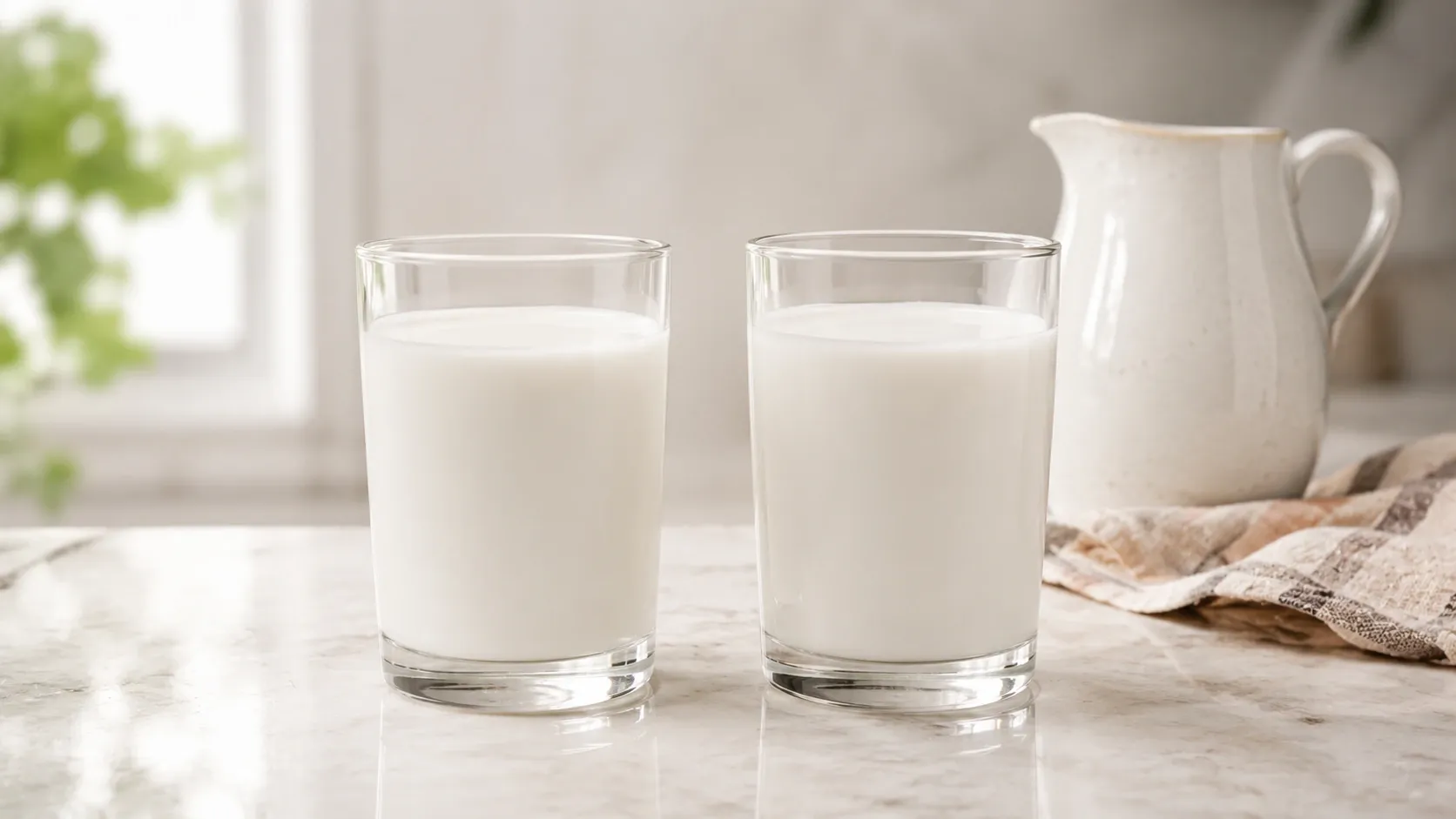
Lactose-free milk has become increasingly common, and the label can easily create the impression that something unhealthy has been removed.
That is not necessarily the case.
For someone who digests lactose normally, lactose-free milk is not inherently healthier than regular milk. Comparable versions generally have similar nutritional profiles. The key advantage is for people with lactose intolerance, who may be able to drink lactose-free milk without the digestive symptoms triggered by regular milk. (NIDDK)
In other words, “lactose-free” describes one specific feature of the food. It is not an overall rating of nutritional quality.
What is lactose?
Lactose is the main naturally occurring sugar in milk.
In the small intestine, an enzyme called lactase normally breaks lactose into two smaller sugars:
- glucose;
- galactose.
These sugars can then be absorbed. (NIDDK)
When the small intestine does not produce enough lactase for the amount of lactose consumed, some lactose remains undigested and reaches the colon. Bacterial fermentation and increased movement of water into the bowel can then contribute to digestive symptoms. (NIDDK)
What is lactose intolerance?
Lactose intolerance occurs when consuming lactose produces digestive symptoms such as:
- bloating;
- gas;
- abdominal pain;
- diarrhea;
- nausea;
- intestinal rumbling.
Symptoms can vary considerably according to the person and the amount of lactose consumed. (NIDDK)
Lactose malabsorption and lactose intolerance are also not exactly the same thing. A person can absorb lactose poorly without experiencing symptoms; intolerance refers to symptomatic lactose malabsorption. (NIDDK)
How is lactose-free milk made?

Several technologies are available, but a common approach involves adding the enzyme lactase to milk.
Lactase splits lactose into glucose and galactose. (PubMed Central (PMC))
This is essentially the same chemical step that occurs during normal lactose digestion in the small intestine.
For that reason, saying that all lactose-free milk simply has its “sugar removed” can be misleading. In many products, the lactose has instead been hydrolyzed into its component sugars.
Some manufacturing systems also filter out part of the lactose before enzymatic treatment, so the final composition can vary by product. (PubMed Central (PMC))
Is lactose-free milk actually healthier?
For someone without lactose intolerance, there is no established general advantage.
The NIDDK states that lactose-free and lactose-reduced milk products can be just as healthy as regular milk products. (NIDDK)
Food-composition research has likewise found broadly similar nutritional profiles between many lactose-free products and their traditional counterparts. (PubMed)
If two products have similar:
- fat content;
- protein;
- micronutrients;
- calories;
- added sugar content;
the lack of lactose does not automatically make one nutritionally superior.
When can it be the better choice?
For someone who develops symptoms after drinking regular milk, lactose-free milk may be better suited to that person’s needs.
It can allow them to obtain milk’s nutrients while reducing exposure to the lactose that triggers their symptoms. (NIDDK)
That is an important individual benefit, but it is different from saying lactose-free milk is healthier for everyone.
Does lactose-free milk contain the same nutrients?

Generally, comparable products retain many of the same core nutrients.
Removing or hydrolyzing lactose does not automatically remove milk protein, calcium, or the other nutritional components associated with dairy milk.
NIDDK specifically lists lactose-free dairy as an option for people with lactose intolerance who want to maintain adequate nutrient intake, including calcium and, where applicable, vitamin D. (NIDDK)
Food-composition research has also found broadly similar nutritional composition between lactose-free and conventional dairy categories. (PubMed)
The important word is comparable.
Whole lactose-free milk should be compared with regular whole milk, not skim milk.
Is lactose-free milk lower in calories?
Not automatically.
Lactose is a carbohydrate. Splitting it into glucose and galactose does not inherently make its energy disappear.
As a result, regular and lactose-free milk with similar fat levels and formulations can have similar calorie contents. (PubMed)
If your goal is to compare calories, focus on the nutrition label:
- calories per serving;
- serving size;
- fat content;
- added ingredients.
“Lactose-free” does not mean “low calorie.”
Does lactose-free milk contain less fat?
No inherent relationship exists between lactose removal and fat content.
Lactose is a sugar, not a fat.
Whole, reduced-fat, and skim versions can all exist with or without lactose.
If saturated fat or calories are your concern, compare the actual fat content rather than relying on the lactose-free label.
Does lactose-free milk contain sugar?
Yes, it may still contain naturally occurring milk-derived sugars.
This is where labels can be confusing.
When lactase hydrolyzes lactose, the result is glucose and galactose. Therefore, lactose-free milk can still contain sugars even when no table sugar or syrup has been added. (PubMed Central (PMC))
A better question is:
Does the product contain added sugar?
The ingredient list and nutrition label provide that information.
“Lactose-free” and “sugar-free” are not interchangeable terms.
Why does lactose-free milk taste sweeter?
Because glucose and galactose taste sweeter than intact lactose.
After lactase splits lactose into these two sugars, many people perceive the milk as sweeter even without added sucrose. (PubMed Central (PMC))
So:
sweeter taste does not automatically mean added sugar.
Manufacturers may use different filtration and processing techniques, so sweetness can also vary between products. (PubMed Central (PMC))
Is lactose-free milk better for diabetes?
A lactose-free claim alone does not make a product better for blood glucose management.
Hydrolyzing lactose changes the form of the sugars in milk, but that fact alone is not enough to classify every lactose-free product as better or worse for people with diabetes. Formulations can differ in total carbohydrates, fat, protein, and added ingredients. (PubMed Central (PMC))
People managing diabetes are better served by looking at:
- total carbohydrate;
- serving size;
- added sugars;
- the rest of the meal;
- their individualized nutrition plan.
Lactose-free milk should not be treated as a diabetes-specific product unless its full nutritional composition makes it appropriate for the person’s needs.
Does lactose-free milk help with weight loss?
There is no basis for treating lactose removal itself as a weight-loss strategy.
If two milks provide similar calories and macronutrients, switching between them does not automatically create the energy deficit needed for fat loss.
The main purpose of lactose-free milk is improved digestive tolerance, not faster metabolism. (NIDDK)
Weight management depends on the overall dietary pattern, energy intake, activity, sleep, behavior, and individual circumstances.
Is lactose harmful if you are not intolerant?
People who digest lactose without symptoms generally do not need to eliminate it simply because it is lactose.
Problems arise when lactose intake exceeds an individual’s ability to digest it and symptoms occur. (NIDDK)
Someone who comfortably drinks regular milk therefore does not need to assume that switching to lactose-free milk will make their diet “cleaner” or healthier.
Does everyone with lactose intolerance need lactose-free milk?
No.
One of the most important features of lactose intolerance is that tolerance varies greatly between individuals.
NIDDK reports that many people with lactose intolerance can consume approximately 12 g of lactose, roughly the amount in one cup of milk, without symptoms or with only mild symptoms. (NIDDK)
EFSA reached a similar conclusion for the majority of people with lactose maldigestion while emphasizing that a universal threshold cannot be established for everyone. (EFSA)
Depending on the person, useful strategies may include:
- smaller milk portions;
- consuming dairy with meals;
- yogurt;
- naturally low-lactose hard cheeses;
- lactose-free products;
- lactase products.
The amount that can be tolerated is individual.
Is lactose intolerance the same as milk allergy?

No, and this distinction is critical.
Lactose intolerance involves difficulty digesting the milk sugar lactose.
Milk allergy is an immune reaction to one or more milk proteins. (NIDDK)
Milk allergy can produce reactions beyond digestive symptoms and serious reactions may be life-threatening. (NIDDK)
Lactose-free milk still contains milk protein
Hydrolyzing lactose does not automatically remove:
- casein;
- whey proteins;
- other milk proteins.
The FDA specifically notes that lactose-free products are generally not suitable for people with milk allergy because the absence of lactose does not imply the absence of milk allergens. (FDA)
What does “lactose-free” mean in Brazil?
Brazilian regulations establish specific labeling thresholds.
According to Anvisa:
| Lactose content | Permitted label |
|---|---|
| Below 100 mg per 100 g or 100 ml | Zero lactose, lactose-free, 0% lactose, or equivalent wording |
| 100 mg to 1 g per 100 g or 100 ml | Low lactose |
| More than 1 g per 100 g or 100 ml | Contains lactose |
The classification relates specifically to lactose content. It does not automatically indicate fewer calories, less fat, or greater overall nutritional quality. (Anvisa)
Should people with lactose intolerance avoid all dairy?
Not necessarily.
Completely excluding dairy without nutritional planning can make it more difficult to obtain enough of certain nutrients. NIDDK specifically highlights calcium and vitamin D in this context. (NIDDK)
Depending on individual tolerance, options may include:
- lactose-free milk;
- yogurt;
- low-lactose cheeses;
- small amounts of regular milk;
- nondairy sources of calcium and other nutrients.
The choice does not have to be “all dairy” or “no dairy.”
Persistent or severe symptoms deserve proper evaluation rather than indefinite elimination of foods without a diagnosis.
How do you know if you really have lactose intolerance?
Gas, bloating, abdominal pain, and diarrhea can occur with lactose intolerance, but they can also have many other causes.
NIDDK notes that diagnosis involves symptoms, medical history, dietary history, and, when necessary, diagnostic testing. (NIDDK)
Lactose intolerance can also be secondary to conditions that affect the small intestine. When the underlying problem is treated, lactose tolerance may improve in some cases. (NIDDK)
Frequent symptoms should therefore not automatically be blamed on milk without appropriate assessment.
How should you choose between regular and lactose-free milk?
A simple framework can help.
If regular milk causes no symptoms
There is no general nutritional need to switch to lactose-free milk.
If regular milk triggers symptoms consistent with lactose intolerance
Lactose-free milk may be a practical option while your tolerance and the cause of the symptoms are assessed.
If you have milk-protein allergy
Lactose-free cow’s milk is generally not an appropriate substitute, because the allergenic milk proteins remain. (FDA)
When comparing products
Look at:
- calories;
- protein;
- total and saturated fat;
- carbohydrates;
- added sugars;
- calcium;
- fortification where relevant;
- ingredients;
- serving size.
A “lactose-free” claim answers only one part of the nutritional question.
Conclusion
Lactose-free milk is not automatically healthier than regular milk.
Comparable products can have very similar nutritional profiles. The main difference is that lactose-free milk is easier to tolerate for people whose digestive systems cannot comfortably handle the amount of lactose in regular milk. (NIDDK)
For someone without symptoms, there is no established general health benefit to removing lactose simply in the hope of reducing calories, fat, or sugar.
Remember that lactose-free milk:
- is still milk;
- can retain milk protein, calcium, and other nutrients;
- is not automatically lower in calories;
- does not mean sugar-free;
- may taste sweeter because lactose has been broken down into glucose and galactose;
- is generally not suitable for people with milk-protein allergy. (PubMed Central (PMC))
For people who truly have lactose intolerance, however, it can be an extremely useful option because it allows them to keep milk in their diet while reducing the likelihood of lactose-related digestive symptoms. (NIDDK)